Global Youth Voices: Fresh Takes on a Flat World
Fresh Takes on a Flat World: The Stories Photos Tell
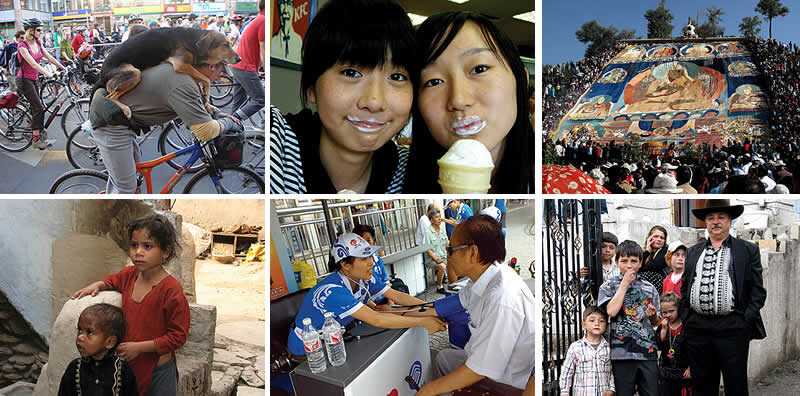
For three years, WKCD partnered with the global philanthropic initiative Adobe Youth Voices, working with students on four continents to capture the world around them through digital photography and short narratives. The partnership produced more than 50 audio slideshows, two photo essay books, a six-month blog by Beijing youth, and an international photo competition and exhibit.
Recently, we decided to develop a “mini-curriculum” for teachers that would tap this incredibly rich resource of youth photography—and make it a spark for classroom learning and discussion.
In a series of short lessons, students use the photos—culled and grouped in three collections from the over 15,000 photos in our image bank—to:
- Appreciate and analyze the stories photos tell
- Develop and improve observational skills
- Expand cultural understanding
- Hone critical thinking skills
- Practice writing
The lessons are suitable for grades 5 to 12, adapted by the teacher as necessary. We also believe they offer a unique platform for language learning in ELL classrooms.
Low-resolution versions of the three photo collections linked to the mini-curriculum:
Youth-produced media, commentary, blogs

Beijing, China
In Beijing, WKCD worked with a team of six students, from several middle and high schools across the cities, to create weekly blogs that featured commentary, photographs, and video and audio clips about issues close to these Beijing youth. The students’ blogs appeared in Chinese on the Chinese blog site, baidu.com. In the U.S., selections of their blogs appeared in English at http://beijingyouthvoices.wordpress.com/.

Budapest, Hungary
In Hungary, we partnered with the Foundation for Democratic Youth (DIA), an NGO headquartered in Budapest that conducts a range of youth programs across Hungary. Our focus was helping youth involved in DIA’s nationwide service-learning initiative document their work and community service activities. In Hungary, as in most of Eastern Europe, the notions of volunteerism and social responsibility died during the Soviet Era. Rekindling this social spirit among a new generation of Hungarians is one of DIA’s main goals.

Cluj Napoca, Romania
In Romania, we teamed up with the NGO Resource Center for Roma Communities in Cluj Napoca. The United Nations declared the first decade of the 21st century “The Decade of Roma Inclusion,” looking to diminish the discrimination and cultural conflict that has kept the Roma population in Romania and across Europe on the margins of society. Our work in Cluj, the urban center of Transylvania, supported a growing group of Roma (gypsy) youth in documenting their city and its culture through the creation of audio slideshows and a touring photo exhibit.

India: Bangalore, New Delhi, Noida
In India, we carried out three distinct projects. In Bangalore, we teamed up with a group of 12-14 year olds to capture a "day in the life" in three very different settings: Bangalore's largest public market, a public park, and the neighborhood where the students lived—one of Bangalore's poorest. In New Delhi, youth leaders in the Bal Panchayat program of Plan International-India took cameras to the slum neighborhoods they know intimately, putting a human face to their passionate campaign for children’s rights in India. Students at Noida Public Senior Secondary School spent the year gathering photographs and interviews that showed the contrasts globalization now produces at every turn in India: between old and new, Eastern and Western, rich and poor, traditional and progressive, multinational and local.

London
As immigrants with few chances to travel outside their working-class neighborhoods, the six eleven- and twelve-year-olds on the AYV photography team at Lilian Baylis School toured their city with wide eyes. For three days, these pre-teens fanned out across London, snapping photos in four different parts of the city: the “hard working” mixed class neighborhood that surrounds their school, Westminster, Jubilee Gardens, and Clapham Junction (a busy, multi-ethnic community). Nothing escaped these young photographers.

Prague, Czech Republic
In Prague, WKCD partnered with the Multicultural Centre Prague on its “Cultures Around the Block” project, a flagship program of The European Year of Intercultural Dialogue 2008. The project brought together young people from diverse ethnic groups across Prague and, through workshops where they documented their surroundings with various mediums, facilitated intercultural dialogue.
In Our Global Village
Welcome to our global service-learning venture!
Adapted from the “In Our Global Village” website, 2006–2011
In Our Global Village began with a collaboration across continents—a friendship between Barbara Cervone, president of What Kids Can Do, and the students of a tiny secondary school she visited in a rural village in Tanzania.
“For us, greeting and shaking hands is like breathing,” these young people told Barbara, showing her the ritual three-part African handshake. “It communicates solidarity.” For days, they took her around the village, introducing her to its ways and traditions, its people and their challenges.
Out of that exploration and documentation by youth, a remarkable book took shape: In Our Village: Kambi ya Simba Through the Eyes of Its Youth.
Its young authors still could not believe that anyone outside their village would care about their story and their lives. “It astounds us,” the students told Barbara, as she took their words, photographs, songs, and stories home to publish through What Kids Can Do.
Thanks to international service learning consultant Cathy Kaye, this solidarity traveled far beyond that first handshake. It sparked a program that connected young people on five continents who gathered and shared their own local stories so that the world can learn from them.
Next Generation Press published three other student-created In Our Village books, beyond the Kambi ya Simba volume. We encouraged teams—from North Hollywood to Nepal—to upload a PDF to Issuu.com, which turned it into a “flipbook.” When the project ended, more than 25 books had been uploaded.