Multi-year projects
Collaborations
Early on, WKCD became involved in multi-year projects targeted at youth learning and perspectives: going to college when you are the first in the family to go, the conditions of learning that help students thrive, social and emotional learning, global understanding, community service, and more. A handful of major foundations were partners in these projects.
Here are five notable examples of these collaborations.
With Lumina Foundation for Education
College Matters: Supporting Low-Income and First-Generation Students
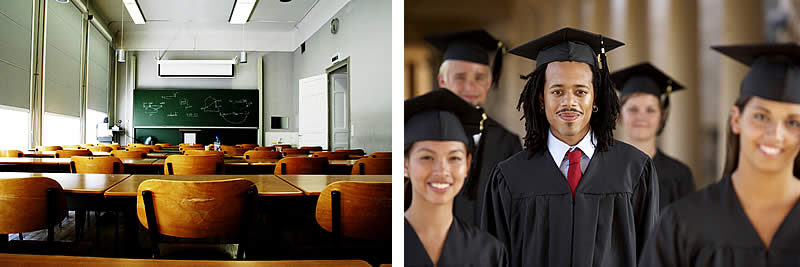
What does it take to get to college, especially if you are the first in your family to go? Where does the motivation come from? What stands in the way? What supports do students need, and where can they—do they—turn for help? How well do they feel their schools are preparing them for college?
We started our “College Matters” initiative, in collaboration with Lumina Foundation for Education, with first-generation students in mind. It soon grew to encompass low-income youth in general. We gathered stories and advice from a diverse group of first-generation college students around the country, from two-year colleges to elite four-year colleges and universities. From these interviews, we produced a portfolio of resources for first-generation and low-income students on how to make it to college and succeed once there. All of these resources are student-to-student: “near peers” advising those following in their footsteps. They are aimed at the adults who support students on the path to college as much as the students themselves.
With the NoVo Foundation
Learning by Heart: Social and Emotional Learning in Secondary Schools
At this school, they go all out around the student’s emotions. They ask, they listen. Me, I feel comfortable here. I don’t wake up and think, “Oh I hope this don’t happen. I hope that don’t happen.” You go in with an open mind and a clear mind and you think like, “I’m okay. I’m fine. I’m ready to learn.”
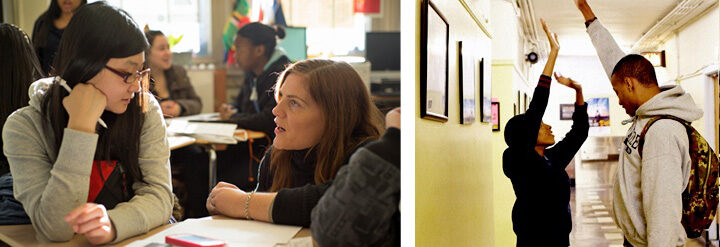
What would it take to weave social and emotional learning (SEL) into the daily fabric of our nation’s high schools? What distinct practices, programs, and structures help schools embed SEL into ongoing teaching and learning? How does this vary from school to school, in response to the conditions that make that school unique, that shape its climate? What formal and informal measures do schools use to assess the impact of social and emotional learning on student success?
With support from the NoVo Foundation, WKCD’s research arm asked these questions and more as part of an in-depth investigation of social and emotional learning in U.S. secondary schools—where the documentation is scant. We’ve parsed the existing research to clarify what’s meant by “social and emotional learning” (SEL) and why it matters. We’ve studied effective practices in five American high schools that, by their own design, put social-emotional learning at their core. We’ve created multimedia to capture the authentic voices and experiences of students in these schools. And we’ve assembled selected SEL resources for educators.
The fruits of this deep dive into social and emotional learning fill the website we created, “Learning by Heart: Social and Emotional Learning in Secondary Schools.” It includes research and commentary, case studies and close-ups, student voices, and strategies for taking action.
The Learning by Heart website was embedded in our larger WKCD site. The link above takes you to that site; the menu at the top no longer works.
With MetLife Foundation
Students as Allies in School Reform
You love school when it makes you feel smart. When you know the teachers care about you and your future, when they act like they think you’ll be someone in life.
In many classrooms across the country, neither students nor teachers feel very smart. The refrains are familiar. School is boring, students complain. It’s hard to see a connection between what we’re taught and the real world. Teachers don’t explain things in ways we understand.
We can’t do everything, teachers respond. Students are unprepared. It’s tough to reach kids whose backgrounds are so different from our own. Too much of teaching is really just classroom management.
What if teachers and students became steady allies rather than frequent adversaries? What would it take for students to become stakeholders not just in their own success but also in that of their teachers and schools?
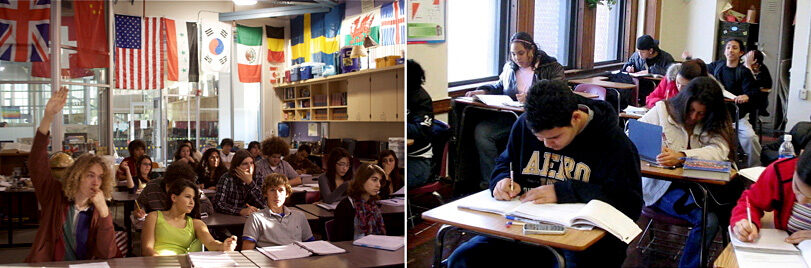
With support from MetLife Foundation, WKCD explored these questions in an initiative called “Students as Allies in School Reform.” In five cities, we helped students and teachers conduct survey research about their own schools, then supported dialogue and constructive action around the results. In all, 21 high schools participated. Students presented their results in all-day, citywide student-teacher forums, and a variety of new practices and structures took root: student advisory councils, student-led parent-teacher conferences, efforts to connect classroom learning with the real world, innovative ideas for strengthening student-teacher relationships, and more.
Since then, the surveys we used in 2004 (and refreshed in 2011) have been downloaded more than 150,000 times—by teachers, education students in college and graduate school, and students.

With the Bill & Melinda Gates Foundation
Student Research for Action
From 2003 to 2006, WKCD had the opportunity to help students and teachers nationwide initiate and conduct ambitious student “action research” projects targeting critical education and community issues. The Bill & Melinda Gates Foundation provided the financial support for this three-year initiative.
Student Research for Action exemplified a number of WKCD core beliefs—that:
- complex problem solving, independent judgment, and teamwork among students and teachers merit a place in every high school’s curriculum
- what happens inside a school’s walls should connect to the world outside
- young people have the capacity to reflect, analyze, and create new knowledge that can then improve their schools and communities.
Under the initiative, WKCD invited student/teacher generated proposals and awarded grants of up to $4,500 on a competitive basis. To be eligible for consideration, proposals had to:
- involve a team of students (minimum of three), supported by two teachers (from different disciplines) and a community partner
- target a problem or issue meaningful to the school/community and show promise of having real impact
- lead participants through an extended period of research that includes a formulation of the problem, a research design, data collection and analysis, and the creation of a final product(s)
- put students in a leadership role, including being the primary authors of the grant proposal
- earn students academic credit of some kind
- culminate in a public school-community presentation and a plan for next steps.
Over three years, WKCD awarded 49 grants, in amounts ranging from $500 to $4,750, to a total of 52 individual schools in 17 states. The student research teams winning support were largely minority youth. Forty-two of the schools were urban, 7 were rural, and 3 were suburban.
With the Adobe Foundation
Global Youth Voices: Fresh Takes on a Flat World
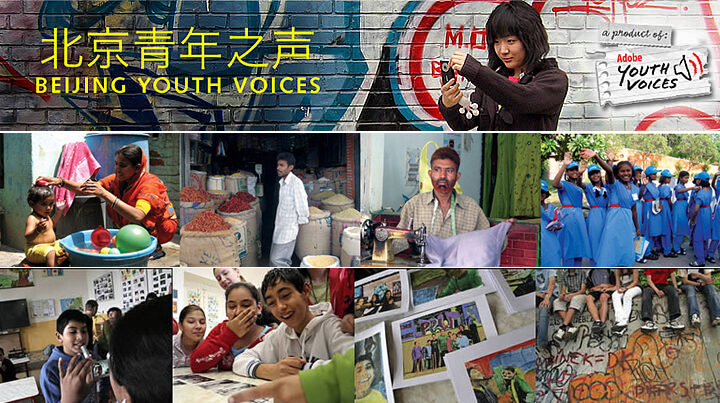
In 2005, WKCD traveled to a small village in Tanzania to work with secondary students on creating a photo essay about life there. Since then, we have carried digital cameras and tape recorders to Bangladesh, Beijing, Ethiopia, London, the Czech Republic, Hungary, Romania, South Africa, Bangalore and Delhi, India—and the smallest village in Japan. Our youth collaborators range from Afro-Caribbean and Muslim immigrants in London to teens living in a homeless shelter in Pretoria, South Africa. We have traveled the globe.
The author Thomas Friedman says we live in a “flat world.” Many of the youth who have participated in these WKCD photojournalism projects would agree. They’d point to the ubiquity of mobile phones, jeans, fast food, CDs and DVDs. They’d show you their photos of “side by sides”: how the old and new, Eastern and Western, traditional and modern, global and local compete for space in cities across the globe—from Beijing to Nairobi.
In the same breath, they would tell you that the differences are still vast, often heartbreaking.
They’d say the gap between the rich and poor, urban and rural, the developed and the developing world seems to have grown as much as it has shrunk. The youth contributing to our Global Youth Voices collection include comparatively affluent teens in Beijing along with the sons and daughters of agro-pastoralists in rural Tanzania; young Burmese refugees in a Bangladesh border camp along with university students in cities across Hungary; Roma (“gypsy”) youth in Noida, India hoping to become part of their country’s new economy. They remind us of the complexities of culture and politics, and how they infuse what we value, what we take for granted, and what amazes us.